



Ebara Hatakeyama Art Museum: Fall 2026 Exhibition
- #Sightseeing
- #Experience
- #Events
- #Hobbies
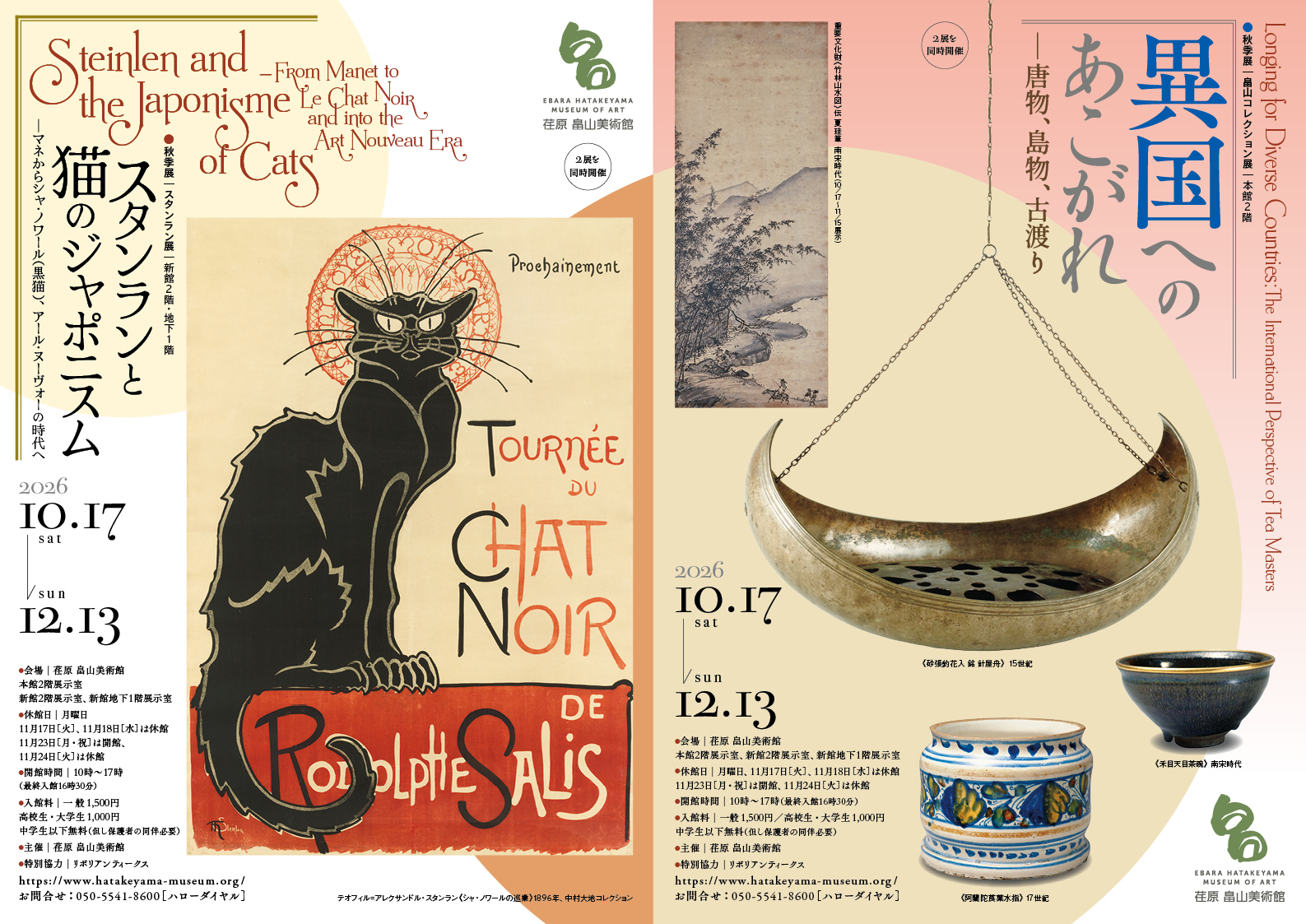
Two Exhibitions on View Simultaneously
◆ [Main Building, 2nd Floor]
“The Hatakeyama Collection Exhibition”: Longing for Foreign Lands—Chinese Imports, Island Imports, and Antique Imports from Across the Sea
◆ [New Wing, 2nd Floor and Basement Level 1]
Stanlan and the Cat’s Japonisme — From Manet to “Cha Noir” (Black Cat) and the Art Nouveau Era
◇ Longing for Foreign Lands—Tang Goods, Island Goods, and Antique Imports
From the moment of its birth, the tea ceremony has always developed, driven by a “longing for unseen foreign lands beyond the sea.” Over the centuries, this longing has taken on different forms—shifting from “admiration (authority)” to “interpretation (aesthetics),” and finally to “global trade (romance).”
This exhibition brings together a collection of the finest Tang-era wares, island-sourced goods, and “Kotori” masterpieces. This is a rare opportunity to experience the passion and discerning eye that people of the past devoted to the beauty of foreign lands. Please come and savor the story of this “longing for foreign lands”—a tale that has captivated our hearts across the ages—at the Ebara Hatakeyama Art Museum as autumn deepens.
◇ Stanlan and the Cat: Japonisme—From Manet to “Cha Noir” (Black Cat) and the Art Nouveau Era
In the late 19th century, as Japanese art—particularly ukiyo-e—gained attention in Paris, the cat, long considered heretical in the West, transformed into an important motif that enriched modern art. Among the artists known for repeatedly depicting cats is Théophile-Alexandre Stanlan.
This exhibition features approximately 100 works, centered on Stanlan, including Western prints and posters as well as Japanese ukiyo-e. Additionally, we will present materials related to Japonisme that are being exhibited for the first time. Using the familiar and charming figure of the cat as a starting point, we invite you to enjoy the encounter with Japanese art that blossomed in late-19th-century Paris and the new world of artistic expression that emerged from it.
[Biography] Théophile Alexandre Steinlen (1859–1923)
Born on November 10, 1859, in Lausanne, Switzerland. He initially worked as a designer at a cotton textile factory in Mulhouse, in eastern France.
In 1881, he moved to Paris with his wife, Émilie, and subsequently based himself in Montmartre, where he produced illustrations, posters, prints, and sculptures. That same year, he worked at the cabaret “Cha Noire,” opened by Rodolphe Sari (1851–1897).
In the 1890s, he expanded his scope of work with projects such as the poster for the ballet *Le Rêve* (1890), which featured Japanese themes; his first solo exhibition at the Bodinier Gallery (1894); and his masterpiece, *The Tour of the Cha Noir* (1896). While painting charming cats, he used anthropomorphism to satirize society and the human character.
He passed away on December 14, 1923, at 73 Rue de Corinthe in Paris. He was 64 years old.
[Exhibition Overview]
Organized by: Ebara Hatakeyama Art Museum
In cooperation with: Liborian Antiques
Dates: Reiwa 8, October 17 (Sat) – December 13 (Sun)
Hours: 10:00 a.m. – 5:00 p.m. (Last admission at 4:30 p.m.)
Closed: Mondays (except November 23 [Mon, National Holiday]), November 17, November 18, and November 24
[Admission Fees]
<Online Ticket Prices>
General Admission: 1,300 yen
Students (High School and Above): 900 yen
<Same-Day Ticket Prices>
General Admission: 1,500 yen (1,300 yen)
Students (High School and Above): 1,000 yen (900 yen)
* Prices in parentheses apply to groups of 20 or more
* Free for middle school students and younger (must be accompanied by a parent or guardian)
* Admission is free for individuals with a disability certificate and one caregiver per person