



"THE FIRST RAILWAY: The Story of the Takanawa Embankment"
- #Sightseeing
- #Experience
- #Events
- #Hobbies
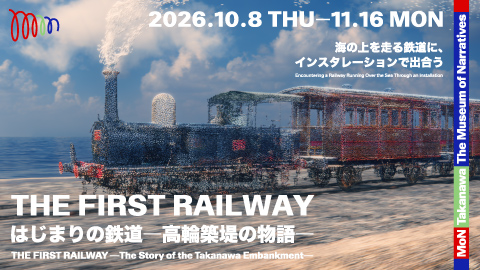
If we can’t go by land, let’s go by sea.
An exhibition showcasing the “Takanawa Embankment”—born of a shift in perspective—and the spirit of innovation that lives on there
Experience the scene of Japan’s first railway in action on a giant screen
One of the highlights of this exhibition is the video installation “A Locomotive Running Across the Sea,” created using point cloud data collected during the excavation of the Takanawa Embankment. Accompanied by evocative music, it beautifully depicts the railway that once ran through this area continuing its journey into the future. Videos projecting history and memories across an entire wall of the venue convey the history of the railroad and the spirit of innovation in Meiji-era Japan with a strong sense of realism.
Historical artifacts unearthed during the excavation are also on display.
The exhibition space features structures modeled after a section of the Takanawa Embankment, as well as stones and pine piles actually used in its construction. At the site where Japan’s first railway ran approximately 150 years ago, scenes from that era are brought to life through both digital and analog media.
What Is the Takanawa Embankment?
◼︎The Takanawa Embankment, over which Japan’s first railway ran
In Meiji 2 (1869), in the midst of the “Civilization and Enlightenment” movement, the government decided to build a railway connecting Shimbashi to Yokohama. However, due to strong opposition in the Takanawa coastal area, construction stalled. This led to the idea of “building tracks over the sea,” resulting in the completion of the Takanawa Embankment over Tokyo Bay at that time. (There are various theories.) This episode allows visitors to sense the spirit of the pioneers who drove modernization through innovation.
◼︎A Fusion of Western and Japanese Technology
British-made rails were laid on top of the embankment, which was constructed using stone wall techniques passed down from the Edo period. Construction was carried out under the guidance of British engineer Edmund Morrell, and despite the lack of construction vehicles and machinery at the time, the railway began operations just two and a half years after the Meiji government’s official decision.
◼︎Remains That Tell the History of the Railroad
The area surrounding the Takanawa Embankment had been reclaimed and disappeared from the late Meiji period through the Taisho era. However, during renovation work on Shinagawa Station in 2019, remains that were believed to be part of the Takanawa Embankment were discovered. Subsequent investigations confirmed that remnants of the Takanawa Embankment still exist. In 2021, “The Site of the Former Shimbashi Station and the Takanawa Embankment” was designated as a National Historic Site, recognized as a crucial site for understanding the history of Japan’s transportation modernization and civil engineering techniques of the time.
◼︎Another Place to Learn More About the “Takanawa Embankment”
THE LINKPILLAR 2 1F GALLERY at TAKANAWA GATEWAY CITY is currently hosting “THE FIRST RAILWAY Exhibition: The Railway at Its Beginnings.” The permanent exhibition features the history of the railway’s opening, an introduction to the excavation survey of the Takanawa Embankment, and video interviews with experts involved in this project.
〈Venue〉THE LINKPILLAR 2 | 1F GALLERY
〈Hours〉10:00 a.m.–7:00 p.m. (Last admission at 6:45 p.m.)
(Closed: Same as the building’s schedule)
〈Admission〉Free
A 6-minute walk from Takanawa Gateway Station.
Details: https://www.takanawagateway-city.com/thefirstrailway/
◼︎Special Talk Event Confirmed
A special talk event titled “The Takanawa Embankment and Urban Design” will be held at MoN Takanawa on Sunday, November 1, from 2:30 PM to 3:30 PM.
The scheduled speakers are Kengo Kuma (architect), Shigeru Onoda (advisor to the Railway Technical Research Institute), and Hiroyuki Yoshimoto (East Japan Railway Company).
Details will be announced on the MoN Takanawa website as soon as they are finalized.