


The Sanko Library is a place where you can “experience” history firsthand—a place that goes beyond the boundaries of a typical “library”!

When people hear the word “library,” many probably imagine a place with a wealth of resources, including popular books and magazines. The “Sanko Library,” located at the foot of Tokyo Tower, pleasantly defies that image.
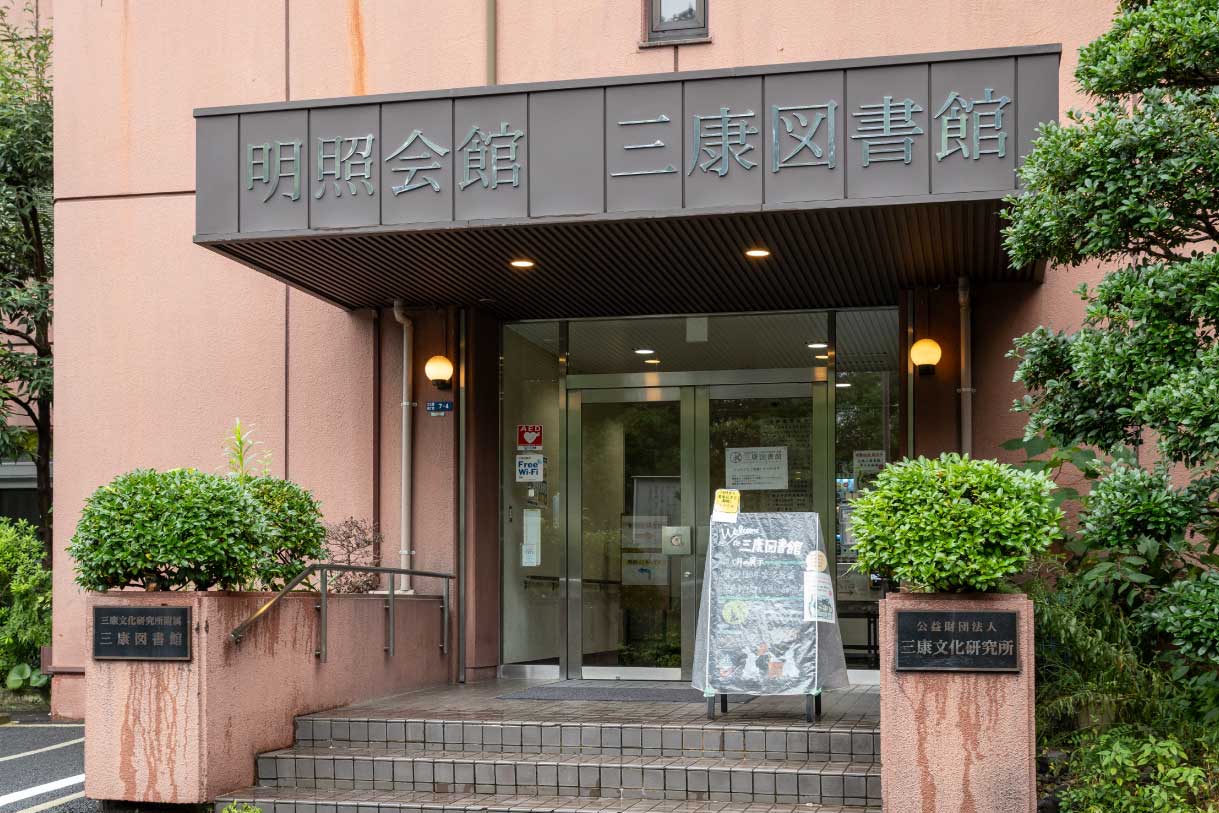
The Sanko Library houses a collection of pre-war popular magazines, children’s books, travel guides, ukiyo-e prints, and Edo-period scrolls—all of which are so valuable and fascinating that they defy the conventional definition of a “library.” And, believe it or not, you can actually pick up and browse through many of these items.
Why has the library assembled a collection of materials on themes that, at first glance, seem random? And is it really safe to make such valuable materials accessible to anyone? We spoke with Mr. Tomotaka Shinya of the Sanko Library’s Collection Department to find out.
Why has the library assembled a collection of materials on themes that, at first glance, seem random? And is it really safe to make such valuable materials accessible to anyone? We spoke with Mr. Tomotaka Shinya of the Sanko Library’s Collection Department to find out.
Why not buy a new book? My priority is the preservation and restoration of books and magazines.
The Sanko Library was established in 1964 (Showa 39) and opened to the public in 1966 (Showa 41). It inherited the collection of approximately 180,000 volumes from the former Ohashi Library, which opened in 1902 (Meiji 35). The former Ohashi Library, which had ties to Hakubunkan, was a private library that had been operating since before the Tokyo Municipal Library existed. Rather than specializing in academic texts, it was dedicated to quickly acquiring the latest books and magazines aimed at the general public, with the goal of encouraging as many people as possible to read.
[What is Hakubunkan?]
One of Japan’s largest publishing houses during the Meiji era. It published popular magazines such as *Taiyo*, *Shonen Sekai*, *Shoujo Sekai*, *Bungei Club*, *Shin Seinen*, and *Yakyukai*, and nurtured numerous writers, including Katai Tayama, Ranpo Edogawa, and Seishi Yokomizo.
The Sanko Library’s collection ranges from books and magazines from the Meiji, Taisho, and pre-war Showa periods to classical texts from the Edo period.
“People often ask me, ‘Is this a library that only collects books published by Hakubunkan?’ but we actually have a wide-ranging collection that includes books and magazines published by other publishers as well.
Besides, we hardly buy any new books these days.”
A library that doesn’t buy new releases? Right off the bat, those words highlighted a key difference from typical libraries.
“We used to purchase new books and academic texts, but now we’re focusing our efforts and budget on preserving and restoring materials, as well as collecting rare books.
A library is a place designed for people to actually handle and use the materials. That’s precisely why we place such importance on preservation and restoration. It’s a major difference from a museum, where items are displayed in glass cases, and it’s a vital role of a library.”
However, books and magazines that have stood the test of time tend to deteriorate due to aging and frequent handling. Yet, precisely because it is a “library,” it is important for visitors to be able to pick up the materials and turn the pages themselves. This means that, in order to serve as a library, we prioritize the preservation of our collections above all else.
“As paper ages, it oxidizes and becomes brittle and crumbly. For this reason, we perform deacidification treatment on old magazines and restore damaged books through rebinding. For classical texts with insect damage, we commission experts to fill in the holes, ensuring that these historical books and magazines remain accessible to the public today.”
“As paper ages, it oxidizes and becomes brittle and crumbly. For this reason, we perform deacidification treatment on old magazines and restore damaged books through rebinding. For classical texts with insect damage, we commission experts to fill in the holes, ensuring that these historical books and magazines remain accessible to the public today.”
From a single memorable page to the experience of actually turning many pages
As of the end of March 2026 (Reiwa 8), the Sanko Library’s collection totaled approximately 260,000 volumes (including about 180,000 items inherited from the former Ohashi Library). The library holds over 7,000 magazine titles.
While staff members search for and replace any missing issues of periodicals, donations from collectors and researchers have reportedly been increasing in recent years.
“Rather than displaying specific pages, we want everyone to be able to pick up a book and read it from cover to cover. That’s why some people tell us, ‘I’d like to donate it to the Sanko Library.’”
“Currently, the National Diet Library also makes digital archives available, but in fact, there are cases where you can’t view the physical copies of digitized books. That’s why some people come to the Sanko Library to see the actual books. When they see the real thing, they’re often surprised, saying, ‘It’s this big!’” says Mr. Niiya.
While digital archives are a convenient system that can be accessed remotely, there’s simply no substitute for the experience of seeing something with your own eyes and handling the actual item. One of the major highlights of the Sanko Library is that it offers experiences—such as the texture of the paper and the smell of old books, not to mention their size—that simply cannot be replicated through digital images.
A Library Tour Where You Can Discover Rare Artifacts, Including a “Winnie-the-Pooh” Book Published During the War
One of the reasons to visit the Sanko Library is the “Stacks Tour,” a guided tour of the five book storage areas led by Sanko Library staff.
The Stacks Tour begins with an explanation of photographs of the former Ohashi Library taken in the early Showa period. Next, they introduced the “card catalog,” which has been in use since the days of the former Ohashi Library and continues to be used at the current Sanko Library.
“Back then, it was common for libraries to have a ‘catalog room’ where rows of card catalogs were lined up. Readers would look for the card of the book they wanted to read, and then have the book brought to them.”
“Shall we head to the stacks, then?” I was prompted, and at last I stepped into the heart of the Library.
The moment I stepped into the temperature and humidity controlled stacks, I was struck by a scent reminiscent of a nostalgic used bookstore. The books, packed tightly on the shelves, were covered in dust-proof neutral paper, and bug traps were placed here and there to monitor for insect infestations. These are all measures designed to ensure the long-term preservation of books and magazines.
In the stacks, they explained the preservation techniques, the library’s unique classification system, and the collection’s distinctive holdings. Furthermore, even as we moved from one section to another, they would stop and point out unique materials, saying, “Oh, this book is interesting, too.”
"This is the section for pre-war children's books. Actually, very few libraries have collections of pre-war children's books. This is a copy of *Winnie-the-Pooh* published in 1942 (Shōwa 17), during the war."
As we made our way through the crowded bookshelves in the library, Mr. Niiya explained one thing after another: “This section here contains collections of entrance exam questions from the old-style junior high schools,” “This book titled *Mental Test Questions* is also interesting. Some people are surprised to learn that the concept of mental tests existed even before the war,” Mr. Shinya explained one after another. Every explanation I heard was fascinating, and I found myself naturally exclaiming, “Wow!” and “That’s amazing!”
"I want to live here!"—even some visitors say that!? Rare materials appear with every step you take between the bookshelves.
A passageway just wide enough for one person to walk through. Lining both sides are the spines of rare books, many of which feature elaborate typefaces and decorations, conveying just how cherished books were back then. As I tentatively touched a book spine with a flutter of excitement, Mr. Shinya said, “Everyone asks at first, ‘Is it really okay to touch these?’ but please, feel free to pick them up.”
“We also have the statement of grounds for appeal from the ‘Mitaka Incident.’ The Mitaka Incident is the unmanned train runaway incident, considered one of the three great mysteries of the Japanese National Railways. These are documents that you normally can’t view unless you go to court.”
“There are also books that once belonged to the Takeda-no-miya family, a former imperial family. They used to live in what is now the Grand Prince Hotel Takanawa VIP Wing, and it seems these books were later donated to the Sanko Library.”
On the magazine shelves—which reportedly receive many requests from patrons—you’ll find titles such as *Asahi Graph* and *Asahi Sports*, as well as publications still in print today, including *Bungeishunju*, *Fujin Koron*, and *Chuo Koron*. In addition, there are magazines featuring a collection of prewar advertising designs.
While prestigious academic works tend to be carefully preserved, there are other types of books—such as magazines, reference books, travel guides, and fanzines—that are used on a daily basis and are often discarded once they have served their purpose, resulting in few surviving copies.
“There are also fanzines published by the literary club of the Nippon Telegraph and Telephone Public Corporation (the predecessor of today’s NTT) and by the literary club for locomotive engineers. Some visitors have even come looking for literary works their grandparents submitted—thinking, ‘There must be something here…’—and asked us to make copies of the pages.”
The descriptions of the books introduced one after another were so compelling that I couldn’t keep up with processing all the information.
I found myself so engrossed in the bookshelves that I was urged to move on more than once with remarks like, “There’s still more of the collection further back…”
As proof of this, while the recommended duration for a tour of the archive is 60 minutes, some visitors have stayed for nearly two hours, and there are even those who say, “I want to live here!” Once you step into this space, it’s easy to understand why you’d want to stay there forever.
Learn about the history of banned books! Don’t miss the exhibition inside the library archives either.
Inside the library, there are also exhibits organized into small, compact spaces.
For example, “banned books” and “books prohibited from reading.”
During the war, some books were banned from reading because they were deemed to disrupt public order. There is a story from the former Ohashi Library about how staff hid books that had been banned from sale or reading, along with their card catalog entries, and protected them by claiming the library “did not hold them.” In other cases, while stamping the card catalog entries with marks such as “Prohibited from Reading” or “Removed from the Collection,” the actual books were hidden elsewhere, allowing them to escape disposal.
“When people hear the term ‘banned books,’ many imagine works that were never released in the first place and could never be read. But in reality, there are quite a few books that were distributed with certain parts redacted.”
Takiji Kobayashi’s *The Crab Cannery Ship* is a prime example.
Holding the actual book in my hands made me suddenly realize just how it had reached readers back then. Mr. Shinya also nods vigorously, saying, “Visitors often tell me, ‘This is exactly what they mean when they say, “Seeing is believing.”’”
In addition, here’s a scene from the section featuring books related to the Great Kanto Earthquake.
“Once, when someone saw a bird’s-eye view depicting the damage from the earthquake and said, ‘Oh, I’ve seen this at another museum!’—well, from our perspective, it was like, ‘We’ve been waiting for this!’ (laughs),” says Mr. Shinya with a laugh.
“Once, when someone saw a bird’s-eye view depicting the damage from the earthquake and said, ‘Oh, I’ve seen this at another museum!’—well, from our perspective, it was like, ‘We’ve been waiting for this!’ (laughs),” says Mr. Shinya with a laugh.
"So, when I ask, 'What do you think is drawn on the back of this bird's-eye view?' people don't know what's on the back. After all, at the museum, you can only see the front. But at the Sanko Library, you can see the back, too."
What’s depicted on the back of the bird’s-eye view? Be sure to check it out at the Sanko Library.
What’s depicted on the back of the bird’s-eye view? Be sure to check it out at the Sanko Library.
The Sanko Library is a place where books from 100 years ago will continue to be in active use.
In the lobby of the Sanko Library, we also organize mini-exhibits featuring books and magazines from our collection.
The themes change every two months. For example, in an exhibition titled “Have Folktales Always Been the Same?”, we compared how well-known stories like Momotaro and Urashima Taro were portrayed in children’s books from 100 years ago. We heard that some parents and children visited the library, picked up those old children’s books, and enjoyed remarking, “It’s different from today!”
“There’s a 100-yen fee to use the seats in the reading room, but it’s fully equipped with power outlets and free Wi-Fi. We really hope people will use it for work and other purposes as well.
We also bring old books and magazines out of the stacks so you can pick them up and look through them—and if you’re just browsing, it’s free (laughs).”
Visitors to the Sanko Library come for a variety of reasons.
Of course, some come to enjoy old magazines; others look for ideas for their work; some pore over old maps, searching for specific buildings in Manchuria or Shanghai during and after the war; and still others flip through photo magazines, thinking, “I heard there’s a snapshot of my grandmother from when she was young in here.”…
The books and magazines in the collection serve as a bridge connecting us to the past, and Mr. Shinya says, “We feel a strong desire not to let the Sanko Library come to an end in our generation.”
All you need is “curiosity”! Don’t hesitate to ask us to find any materials that catch your interest.
You might think that only experts in the field need old books, but Mr. Shinya says, “Please don’t hesitate to visit us at all.”
“It can be quite a challenge to search for books and magazines you’re not familiar with. So, if you let us know what kind of books or magazines you’d like to see, we’ll find the ones that match your request—please don’t hesitate to tell us.”
For example, “I want to find my ancestors’ birthplace, so I’d like to see an old map of the ●● area,” “I’d like to see ukiyo-e prints,” or “I’d like to see a magazine featuring this kind of pre-war photograph”—all we need is the starting point of your interest.
From there, by letting a professional who knows the stacks inside and out guide you, you’ll discover books and magazines that let you experience the atmosphere of that era.
Finally, I asked Mr. Niiya, who had shown me around the vast library, which section he liked best. After thinking about it for a while, he replied that it was the Fourth Library, which houses a collection of pre-war educational books, travel guides, and entertainment-related books.
“It’s a place with books from a wide variety of genres, not just dictionaries and textbooks. The exhibition of banned books is also in the Fourth Storage Room. I think it’s a storage room where you can really feel the variety—or rather, the diversity.”
The Sanko Library not only collects and preserves old books and magazines but also passes on new information gained from visitors to the next generation. To allow people who work on weekdays to visit, the library is open on the third Sunday of every month.
While regular book loans are not available, photocopying is permitted within the limits of copyright law (for a fee).
While it’s easy to look up simple questions online, the beauty of physical books is that when you actually pick up books and popular magazines from that era, you can learn not only what you set out to find but also a wide range of related information—realizing things like, “Oh, this was actually from the same era too,” or “It hasn’t changed even after 100 years.” Engaging with the past can open up a whole new world.
Why not pay a visit to the Sanko Library, where you can see and touch the past for yourself and answer that question: “What was it really like back then?”
Why not pay a visit to the Sanko Library, where you can see and touch the past for yourself and answer that question: “What was it really like back then?”